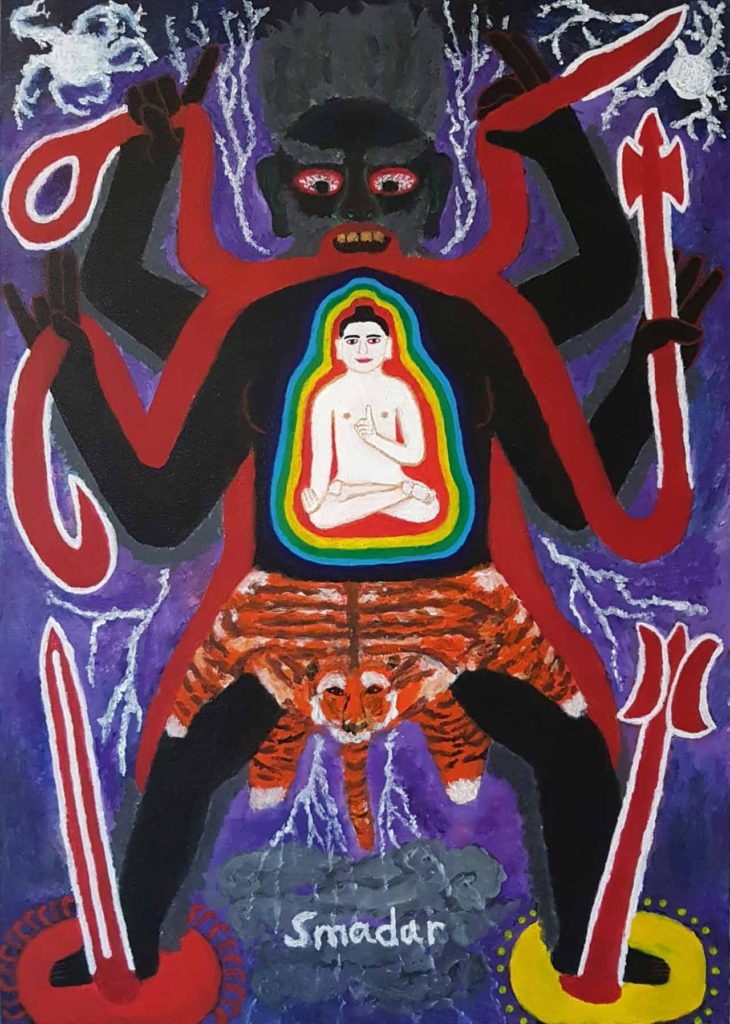

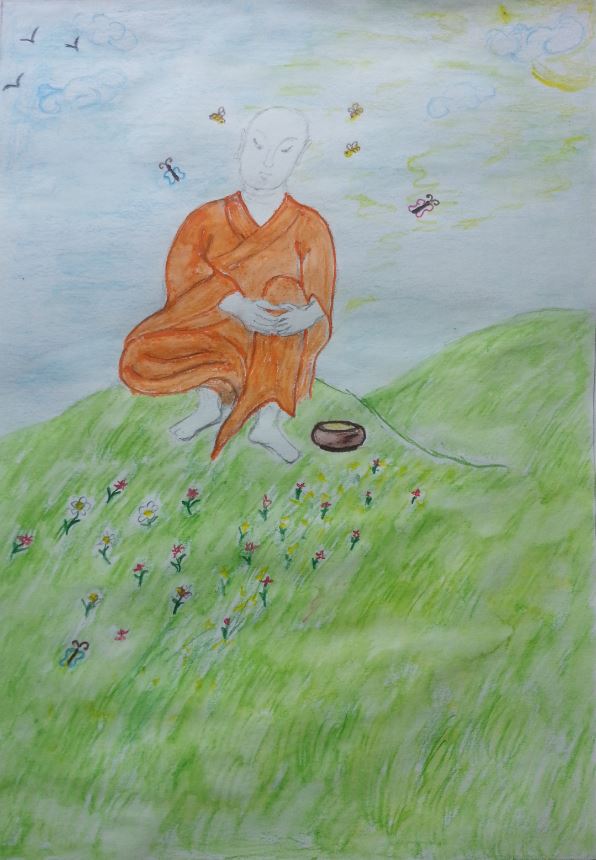
Ananda
Ananda was Buddha’s cousin as well as one of his closest disciples. Though Buddha had different assistants, they were not always around. When Buddha was 55 years old he felt that he was getting older and needed an assistant to help him with his affairs. When the sangha gathered to discuss the matter many suggested themselves; only Ananda remained silent. Buddha made his choice of Ananda for his modesty, devotion and purity of intentions. Buddha and Ananda were of approximately the same age. For the following 25 years, until Buddha’s death, Ananda followed Buddha everywhere, cleaned his abode, helped in everyday and sangha affairs, and tried to remember every word of his Teacher. In spite of direct and almost constant closeness to Buddha, and having attained the first level of realization (“entering the stream”), Ananda made little additional progress in his spiritual path. Buddha’s other disciples moved forward and attained enlightenment, but for Ananda this state was unachievable and this fact saddened him. From sutras we learn that Ananda’s doubts were dispelled when in Buddha Shakyamuni’s presence he had a vision of Sukhavati, Buddha Amitabha’s pure land. In Mahaparinibbana sutra there is an episode where Ananda, after learning Buddha’s intention to leave this world, is begging him to stay, but Buddha remains adamant. “Ananda said this to the Gracious One: “Let the Gracious One remain, reverend Sir, for the lifespan, let the Fortunate One remain for the lifespan, for the benefit of many people, for the happiness of many people, having compassion on the world, for the welfare, benefit, and happiness of Divinities and men.” “Enough, Ananda, do not beg the Realised One, now is the wrong time, Ananda, for begging the Realised One.”… “At one time, Ananda, I was living at Rajagaha on the Vulture’s Peak Mountain…, in that place, Ananda, I addressed you, saying: …Whoever has developed, Ananda, made much of, carried on, established, maintained, augmented, and properly instigated the Four Paths to Power, could, if he wanted, remain for the lifespan or for what is left of the lifespan. The Realised One has developed, Ananda, made much of, carried on, established, maintained, augmented, and properly instigated the Four Paths to Power. If he wanted, Ananda, the Realised One could remain for the lifespan or for what is left of the lifespan.’ But despite such a gross hint being made by the Realised One, such a gross suggestion being made, you were unable to penetrate it, and did not beg the Realised One, saying: ‘May the Gracious One remain, reverend Sir, for the lifespan; may the Fortunate One remain for the lifespan, for the benefit of many people, for the happiness of many people, out of compassion for the world, for the welfare, benefit, and happiness of Divinities and men.’ If you, Ānanda, had begged the Realised One twice the Realised One might have rejected your speech, but would have accepted it on the third occasion. So, Ānanda, there is this wrong-doing for you, there is this fault for you.” It is as if Buddha is blaming Ananda for being insensitive and refuses his request, reminding him about the impermanence of all things, saying: “Did not I tell before, in other situations that sooner or later we have to part with what is dear to us, with what is close to our heart, that we will have to leave it forever?” Buddha predicted that after his death Ananda will attain enlightenment and so it happened. Ananda became the second Buddhist patriarch, “the Knowledge keeper”, and most of “Pali Canon” and “Sutta Pitaka” were recorded from his words. It is owing to him that we can read Buddha’s words now. Among Buddha’s other disciples Ananda’s personality is notable for his imperfection. For a very long time he was unable to attain liberation. He also was troubled by the death of Sariputta, his close friend. After Buddha’s death he felt loneliness and isolation and doubted his own ability to attain liberation. This imperfection makes Ananda’s image so close and human to us, showing that the path to liberation from suffering is accessible to all who are sincere and devoted in their service. In this way imperfection itself becomes a ground for liberation. So it was in Buddha’s days and so it is in our days. Comments: When we discussed the story of Ananda with my Teacher, Vova Pyatsky, he made the following comments: Ananda was a devotee, a voluntary servant of Buddha, but at the same time he felt as if he were isolated from the world, even as if he were a failure. He had no personal life, he did not have even minimal freedom like freedoms of other monks who received initiation. All of his time and power he devoted to service to Buddha, often in very common everyday affairs, affairs which he did not demand high thoughts on Dharma and prolonged hours of meditation. Even though Ananda had an intellectual understanding that his situation was in fact a privilege and honor for him, he still felt himself like an outcast. He felt disgraced by his position as a servant. While others attained insights and realizations Ananda, though being so close to Buddha and remembering his every word, seemed to lose even the slightest hope for liberation. No wonder that sadness and depression settled in his heart. Already knowing about the approach of his own death Buddha reproaches Ananda with insensitivity: in “Mahaparinibbana sutra”. He says to Ananda that before it was time to ask Buddha to delay his departure, but at that moment it’s too late as for so long they were together. And when Buddha was drawing Ananda’s attention to beautiful places he was sort of saying: “Ananda, wake up, look at this place, where I am present. Your consciousness is present here as well. You are not to leave it.” In this way Buddha was indirectly pointing to Ananda’s heart. In numerous mirrors Buddha was showing Ananda the beauty of the nature of mind. We can
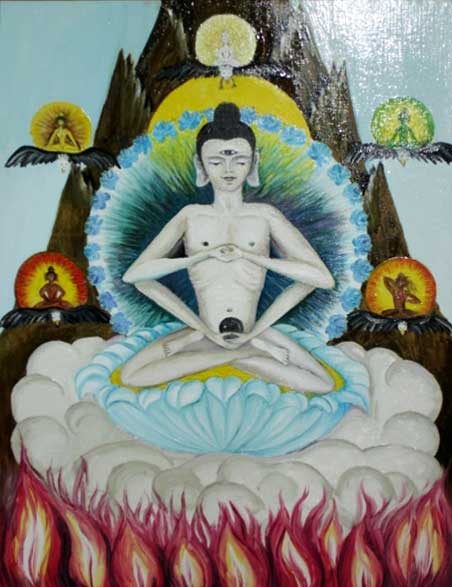
The White Buddha
Vairocana is a disciple of all other Buddhas and Dakinis and represents the image of the ideal student: respectful, modest gatherer of all the teachings with the mind supple as bamboo, an example for the whole Sangha. With all the qualities of an ideal student, he helps the practitioner to take refuge in the Three Jewels (Buddha, Dharma and Sangha). Taking a decision about accepting refuge in the Three Jewels is the beginning and the foundation of the Path. The Three Jewels – Triratna The Three Jewels of Buddhism are: The mind nature of Buddha gives us shelter from fear. All fear is really a fear death. Even when we lose simple and everyday objects we experience helplessness and danger of death. For a mind, death is as shallow waters and it can be simply crossed over. The nature of mind is not being trapped in the body, thoughts or experiences, so death is like shallow waters for it. Dharma gives us refuge from the desire to benefit. Since all is variable and not constant in the material world, the only true benefit is in learning the Dharma. Sangha gives us refuge from disturbing emotions. Sangha develops our Immeasurable Feelings through interaction with other Sangha members. Accepting the refuge in the Three Jewels makes us good disciples and gives us confidence that we can progress on the Path.
Mulapariyaya Sutta, The Root of All Things
The Buddha’s Sermon In aconversation with his disciples, the Buddha states that an untrained person, an advanced disciple, an Arhat and a Tathagata, perceive phenomena in different ways. They perceive the elements of form (earth, water, fire and air), bodily beings, gods, Prajapati, Brahma, the gods of Radiance, the Beautiful gods, the gods of the Perfect Fruit, the ruling gods, infinite space, infinite consciousness, emptiness, nonduality, activity of senses and mind, unity and division, the totality of all phenomena and nibbana – differently. Worlds listed by the Buddha First, the Buddha lists the levels of the Kamaloka (the world of desires). Among them mentioned are the world of bodies consisting of four great elements (earth, water, fire and air), the heaven of the gods of desires, the world of Prajapati (the forefather from whose body all beings of the human, animal, vegetable and mineral worlds originated) and the world of Brahmas – creators of phenomena. Then, the Buddha mentions the levels of the Pure Lands of the Rupa sphere, which is the abode for the shining, beautiful, perfect and ruling gods. Then, the Buddha mentions the four formless concentrations: meditation on the infinite space and consciousness, emptiness and non-duality. After that, the activities of the mind and feelings and their exploration and termination in the sphere of Arupa (with no forms) are described. Difference of perceptions The Buddha says: An untrained person perceives all phenomena as something with an essence, they are fascinated by them, strive to possess them. On the contrary, an advanced disciple, an Arhat and a Tathagata are not fascinated with phenomena and do not seek possession, they see the insubstantiality of all worlds and phenomena. In turn, the perceptions of an advanced disciple, an Arhat and a Tathagata also differ from each other. An advanced disciple knows that he must comprehend the Anatta (absence of “I” in phenomena), and is focused on a dispassionate perception that does not develop attachment and aversion (this attitude to perceptions characterizes the development of mirror-like wisdom). An Arhat (a perfect pupil who has reached the goal) perceives phenomena, having already achieved a dispassionate state. He achieved awareness and cessation of the causes of confusion: lust, hatred and delusion. Therefore, he effortlessly comprehends the qualities of things, without distorting them. Tathagatas know the causes of the emergence of the formation, dwelling and destruction of all phenomena. The Tathagatas comprehended the truth that any kind of existence and non-existence, or non-dual state (neither existence nor non-existence) is suffering (it is the perception of Tathagatas that defined the name of the given sutta: “the root of all things” – this root is suffering). Tathagatas have destroyed the dependence of the mind on any kind of perception and have completed the accumulation of true knowledge. Therefore, they perceive all phenomena without ignorance. Through this, they achieve complete Awakening and the cessation of suffering. Reaction of the disciples Sutta ends with the words: “But, hearing the words of the Blessed One, the disciples did not rejoice.” The implied interpretation of these words it that this teaching was difficult for the disciples present at the sermon. Another interpretation – the disciples, practicing the teachings, are captured by the idea of dispassion, and do not develop admiration. But more importantly, the very fact that there is no emotional reaction of the disciples is the impassive statement of Ananda, from whose words the sutta is written.
1. Brahmajala Sutta
Introduction The Sutta begins with a reference to the dispute between a wandering ascetic and his disciple. The ascetic strongly condemns the Buddha, Dhamma and Sangha, while his young follower praises the Three Jewels in every possible way. The disciples of Buddha discuss this dispute in the Sangha. Buddha, after learning about the subject of their discussion, instructs: it is necessary to speak without anger and hatred about the virtues of the Three Jewels, because dislike of criticism and people who criticize can only damage the defenders of Buddha, Dhamma and Sangha. The statement about the insignificance of praise, born by worldly consciousness Then, the Buddha asserts that praise, coming from people with worldly thinking, is negligible.It is insignificant because it will describe only the superficial virtues of the Buddha’s external behavior, but not his subtle or profound wisdom which is difficult to understand.The Buddha describes in detail the precepts of monastic behavior observed by him, and emphasizes that the purity and restraint of his actions are the only thing accessible to the understanding of the worldly man. What does the Buddha consider truly amazing in his own wisdom? That His wisdom goes beyond the sensory perceptions.In the Brahmajala Sutta, the wisdom of the Buddha is represented by an understanding of how all judgments about the past and the future arise, and also what are the consequences of these judgments. First, the Buddha enumerates and explains all kinds of judgments, and only at the end of the sutta – explains them in accordance with his own wisdom. Judgments about the past Judgment: the world and the “I” are eternal. The Buddha says that with the help of seriousness, concentration and other qualities of asceticism, venerable hermits and brahmans remember their past incarnations in this or that place, at one time or another, under this or that name. And therefore they come to the conclusion about the eternity of the world, lonely, standing like a pillar, and the eternity of the “I”, incarnating again and again. Otherwise, devotees come to this conclusion by reasoning and inferences. Judgment: the world and the “I” are partially eternal, and partly non-eternal The Buddha discusses faith in the partial eternity and non-eternity of the world and the “I”. In this section, three supernatural cases of the recollection of the past, relating to the world of Brahma and the worlds of the gods are discussed, as well as the process of coming to this faith by reasoning and inference. The memory of the past birth in the Brahma world is as follows: There are periods when the whole world collapses and then there are beings that abide in radiance. They consist of mind, they feed on joy, radiating glow, moving in space, being in glory. All this goes on for a very long time.Then appears the empty palace of Brahma. Those beings whose term has come are born into it. Born in this palace (which is, in fact, the original model of the sense of “I”), the being, albeit blissful, begins to worry, feel lonely and think “Oh, if other beings were also in this state”.Then other beings are born in Brahma’s palace, and they perceive the previously born being as Brahma, because it was there before them. In addition, the creatures born earlier live longer, are more beautiful and strong. Therefore, they retain their position in the palace longer, while the beings born later are forced to incarnate in the earthly world. Reborn in the earthly world, these beings sometimes become venerable hermits and remember their past state and events in the Brahma’s palace. Thus they come to the conclusion about partial eternity (relating to the splendor of the world of Brahma) and partial non-eternity (relating to the sufferings of the earthly world). The memory of the past birth in the assembly of the gods “Spoiled by Pleasure” is as follows: There are gods that are attached to pleasures, committed to them beyond measure. Because of this attachment, their ability for self-knowledge is weak, and they are forced to abandon the heavenly world and incarnate in the earthly. Some of them, through earnestness, concentration and renunciation, begin to see their past birth in the world of the gods. Because of this memory, they come to the conclusion about the existence of a partial eternity (the world of the gods) and partial non-eternity (the earthly world). The memory of the past birth in the assembly of the gods “Spoiled by the Mind” is as follows: There are gods inclined to condemn each other (to argue with each other). They become entangled in their judgments and weaken their body and thoughts. They leave their host and are born in the earthly world. Then, those who stood on the path of concentration, can recall their past birth and come to the conviction of the eternity of the celestial state and the non-eternity of the earthly state. The two following groups of judgments about the world and the “I” do not have a clear connection with memories about the past (it can be assumed that in the sutta there is a fusion of various instructions connected by the general theme of “judgments about the world and “I”). Judgment: the world and the “I” are finite or infinite Such views are built on the fact that by means of concentration, diligence, and asceticism, venerable hermits and brahmans gain a vision and conviction of the finiteness or infinity of the world and the “I”. The same methods of research often lead to opposite conclusions, because researchers get conviction in this or that observation, but not in anything beyond it. Judgment: lack of certainty These are the views of those who are afraid of expressing a certain judgment and thus behaving slippery like a fish. They are afraid to become victims of their own involvement in judgments, or fall into hate from judgments, or be confused by detailed questions about their judgments. Judgment: the world and the “I” appear without reason (Here there is a return