The Three Vajras

Roni Sherman

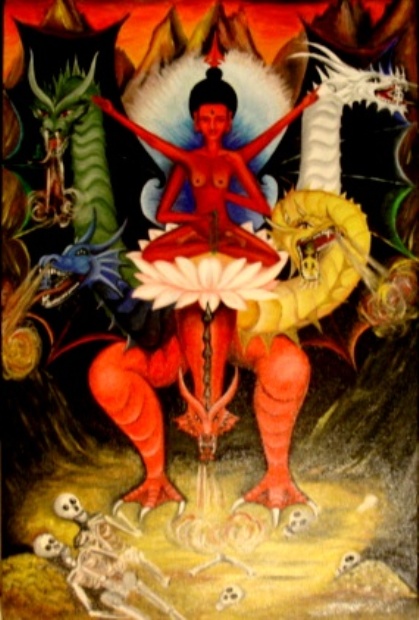
Red Tara

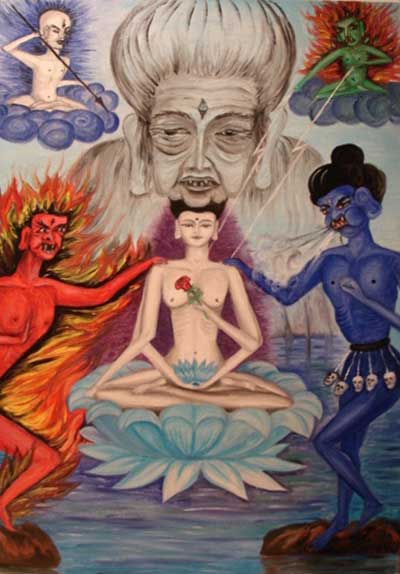
The nature of the Red Tara is dynamic. She is depicted dancing, or in an angry posture with sharp teeth, hair standing on end and angry attributes like skulls and dagger. She covers the entire cycle of energy and as its mistress, she sets it in motion (stomach receives energy of food). Her Infinite Feeling is Benevolence. The correct form of Benevolence towards all sentient beings is wanting them to wake up from the nightmare of ignorance. Therefore, the Red Tara is the awakening Dakini. She awakens the living beings from Samsara’s nightmares. She is characterized by spontaneity. When a disciple understands that all the nightmares are dreams of Samsara, they experience liberation, lightness, and a sense of relief. The strength of the stomach (hunger) awakens the person from sleep. This hunger is the thirst for Learning. Red Tara helps to overcome the Five Hindrances (which are five types of dreams of Samsara) on our Path to enlightenment: The Five Hindrances are unskillful qualities of the mind, leading to sinking into the Lower Realms. The Hindrances must be suppressed by the means of purifying the consciousness. Their root is in the “I”, therefore skillful action will be cutting off the feeling of “I”. The correct antidotes for the Five Hindrances: Developing these good qualities will suppress those Hindrances in practice.

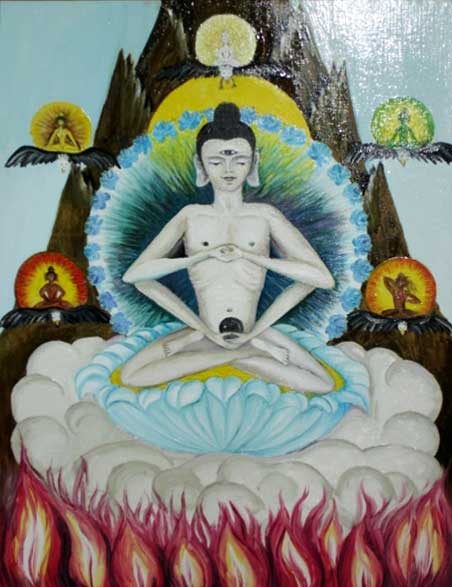
The Blue Buddha

The essence of his teachings is the interdependence that exists on the process of occurring of all phenomena – the doctrine of the Twelve Nidanas. The mutual dependence of occurrence of all phenomena means the lack of existence of the “I”. The Twelve Nidanas are twelve links of interdependent occurrence of all phenomena, that is, there is no independent or permanent source from which these phenomena would occur. Consequently, there is no permanent and sustainable “I.” This teaching is inseparable from the teaching of the Four Noble Truths: there is interdependent formation of suffering (Twelve Nidanas); suffering has its cause (Three kinds of Thirst); there is cessation of suffering; and there is a Way leading to the cessation of suffering. By his nature and behavior, the Blue Buddha is magician, Vidyadhara (“Vessel of Knowledge“). Vidyadhara is a siddha yogi, living mainly in the magical reality. His behavior and actions on the physical level incomprehensible to the people around him and are often seem crazy, so Vidyadharas often called «crazy yogis». He lives in the reality, which is not subject to the ordinary laws. Vidyadharas’ or Buddhist mahasiddhas’ image is central to the Buddhist literature. Why the Immeasurable Feeling, inherent in him, is Loving Kindness? Loving Kindness is the most insane of all the feelings. Man’s mind at any given point in time is able to love and to be focused on only one object. This human ability to truly love someone and be genuinely interested in someone – it is devastating for the egoism, because at that moment the person ceases to concentrate on himself. Vidyadhara is the one who does not care about his reputation or the comfort provided by the society for his feeling of “I”. Loving Kindness breaks the comfort zone, to which we are so accustomed – as the chick breaks the shell of the egg to come out. This breakthrough is as sudden and spontaneous as the spontaneous transfer of enlightenment. For the worldly mind, Vidyadhara – a madman who, in loving people around him, does not love himself and does not appreciate his own comfort. This is the madness of love. Blue Buddha is often depicted in royal robes, which are not, however, conventional terrestrial , but space-like garment, woven of light. His energy is similar to the energy of the stars and the wind, and he is dressed in shining radiance. His appearance is of an ascetic and of the king at the same time. Blue Buddha is a wanderer and appears where he wishes, and in the form in which he wants.

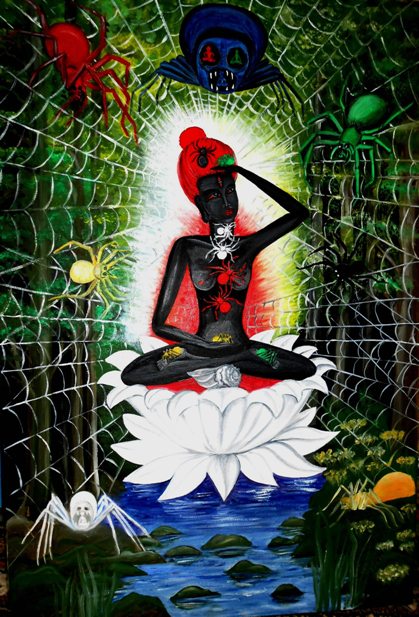
Black Tara

Repentance is usually perceived as a necessary but unpleasant thing. A person works their way through repentance and then tries to avoid it in order not to remain in guilt. This approach is deeply flawed because Repentance is an Immeasurable Feeling. And like any other Immeasurable Feeling, it frees. When we experience other Immeasurable Feelings such as Loving Kindness, or Peace, we don’t feel this need to “get away” from them. When it comes to Repentance a practitioner suddenly has a very different attitude. This is not the right attitude toward Repentance. True Repentance purifies the mind from external and internal actions which are an expression of an incorrect motivation. In the process of Repentance, we begin to separate between the purified mind and our passions and desires (the Three Thirsts). This liberated mind begins to be filled with all the other endless feelings and becomes joyful and pure. In the process of right Repentance, a practitioner comes to all the experiences of meditation (to the Bliss, Clarity and Silence of mind). Genuine Remorse is joyful, because the practitioner rejects the causes of negative behavior – the desires. The mind experiences joy of freedom as it is now free from the tendency to sink into dark states of consciousness. Guilt that often arises when doings are wrong, is based on the fear of punishment and treated with proper Repentance. Why? Because Repentance frees us from the causes of the commission of certain acts (desires), it eliminates the subject, that feeling of “I”, which feels a sense of guilt. Correctly done Repentance is similar to the light of a candle, illuminating the darkness, while the guilt is like the darkness, in which consciousness sinks. The Black Tara corresponds to the gallbladder. Bile has a fiery character. It is where all the filth of the mind is burned. Bile fire is clear and hot. Healthy bile (and its healthy flow in the body) gives mental clarity. The Black Tara teaches us about the Bodhicitta, about the Samaya vows and about the Bodhisattva ideal. They all are the basis for proper Repentance. The ideal of the Bodhisattva is bright, fiery, full of Repentance, because it is based on awakening. A person suddenly realizes how ridiculous and absurd it is to live in pursuit of worldly goals. The ideal of the Bodhisattva, therefore, provides a correct understanding of Repentance. The main object of Repentance for a practitioner is that he is currently not yet enlightened. And if he is enlightened, he regrets that the whole world and the whole mandala in which he resides are not yet enlightened. Therefore the Repentance is an Immeasurable Feeling. The Black Tara is ascetic. She is portrayed either completely naked or in jewelry made of bones. Black color is a sign of the energy of protection. Nothing protects a person better than Repentance. Therefore Black Tara does not require robes. In Repentance the mind appears naked: reset are all the worldly accumulations of the mind, the whole “make-up“. Her look is wrathful and strict, stern and merciful all at the same time, because the Black Tara is a defender of all practitioners.

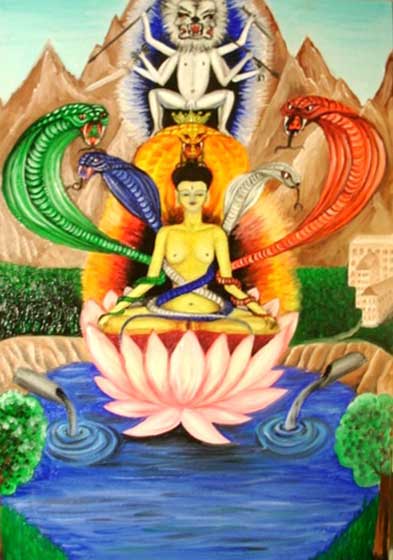
Yellow Tara

Her transfer of teaching is the most “human” one among those of other Buddhas and Taras (best suitable for human beings); her language is  purely human. Her teaching is based on the explanation of human communication (that is, what is the reason people tend to unite into families and Sanghas). Yellow Tara describes precisely the phenomenon of human communication and commitment to each other. Her theory (doctrine) is more ancient than Buddhism, and consists of the fact that the whole universe comes from a single point (“point of singularity“). Her mandala resembles a kaleidoscope and has a certain set of colors. Performing mandala offering of the Yellow Tara, we must build a mandala every time a little differently, as if turning the kaleidoscope. The traditional Kalachakra Mandala, which is made in Tibet, is laid out with sand for several weeks and always has the same pattern that symbolizes the Space Palace. And then it is destroyed by a single wave of hand. In destroying mandala we express the experience in which the mandala is reunited with emptiness. At home, you can build the mandala with colored pebbles or colored mosaic tiles. Sweeping pebbles/tiles with a wave of hand reminds us of the illusory nature of all existence. By practicing that, we begin to realize that the Three Meditation Experiences (Bliss, Clarity and Absence of Thoughts) are just a reflection of the Nature of Mind. What is the Space Palace? It is a palace of the Immeasurable Feelings. Typically, the Yellow Tara mandala is divided into four parts plus the center (five parts in all). The four parts are called Brahmaviharas (Endless feelings) – Loving Kindness, Compassion, Joy, Equanimity (Peace). We are exploring the endless feelings in the Mandala of Pure Lands, too, but the mandala of the Yellow Tara (the Mandala of Endless Feelings) sounds majestically like an echo, sounding muffled and wide. Her doctrine reminds us that all creatures evolved from a single point and that they all carry the memory of the common root, that we all were once a single whole. This memory is rooted in us all like an echo of the original state (that is what sounds so majestically) and explains the desire of all people to unite with each other.

Green Tara

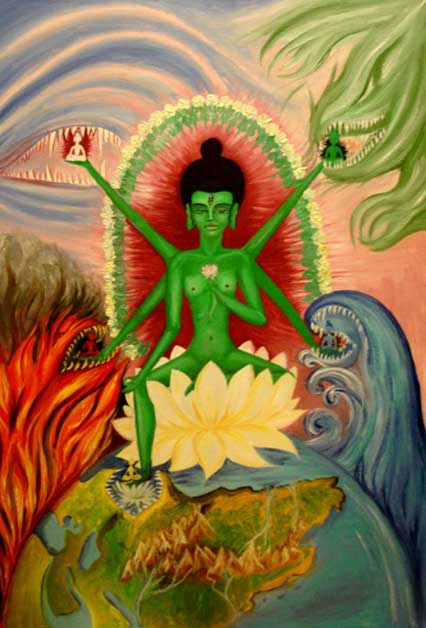
Joy is the only infinite emotion that all beings want to feel. Its uniqueness is universal: all beings want to be happy. No creature in existence wants to be sad or scared. When meditating on the emotion of joy, we must understand that this feeling is something that is much more, than the external reasons that we usually associate with. It is necessary to study its absolute nature that represents the nature of mind. Joy gradually softens and refines the mind and leads to its transparency and depth of clarity. Since all beings want to be happy, what distinguishes between them is the dexterity level of their mind, the way in which they want to feel happy. This difference in mind’s skill level determines which world out of the Six Worlds of Existence is most suitable for a sentient being to reincarnate in. The Green Tara is regal. Her royalty is not irate but soothing: she is seen not as a queen, but as a princess. She has a nature of renunciation. She pulls away from mundane and absorbs narcissism, since her joy is pleased with itself and nourishes her. She does not need anything else. She nourishes the very basis of human consciousness – its “awakenness”, its Buddhahood. The organ that represents the Green Tara is small intestine, an organ, that nourishes the blood, and therefore the entire body. The Six Realms of Existence Those, who put together wisdom and compassion, remove all limits and untie all chains. The ground for wisdom is in every breath. The seed of compassion is an ordinary awareness of what’s going on, without any distraction in thoughts. The obstacles for the realization of the Truth are the following: – altogether these are the six diseases/obstacles. The human birth is precious for disciples. It leads to the cure of all diseases in patient and well-wishing disciples, but brings to the aggravation of the all diseases/obstacles in the ignorant and unrestrained disciples.

Ananda

Ananda was Buddha’s cousin as well as one of his closest disciples. Though Buddha had different assistants, they were not always around. When Buddha was 55 years old he felt that he was getting older and needed an assistant to help him with his affairs. When the sangha gathered to discuss the matter many suggested themselves; only Ananda remained silent. Buddha made his choice of Ananda for his modesty, devotion and purity of intentions. Buddha and Ananda were of approximately the same age. For the following 25 years, until Buddha’s death, Ananda followed Buddha everywhere, cleaned his abode, helped in everyday and sangha affairs,  and tried to remember every word of his Teacher. In spite of direct and almost constant closeness to Buddha, and having attained the first level of realization (“entering the stream”), Ananda made little additional progress in his spiritual path.  Buddha’s other disciples moved forward and attained enlightenment, but for Ananda this state was unachievable and this fact saddened him. From sutras we learn that Ananda’s doubts were dispelled when in Buddha Shakyamuni’s presence he had a vision of Sukhavati, Buddha Amitabha’s pure land. In Mahaparinibbana sutra there is an episode where Ananda, after learning Buddha’s intention to leave this world, is begging him to stay, but Buddha remains adamant. “Ananda said this to the Gracious One: “Let the Gracious One remain, reverend Sir, for the lifespan, let the Fortunate One remain for the lifespan, for the benefit of many people, for the happiness of many people, having compassion on the world, for the welfare, benefit, and happiness of Divinities and men.” “Enough, Ananda, do not beg the Realised One, now is the wrong time, Ananda, for begging the Realised One.”… “At one time, Ananda, I was living at Rajagaha on the Vulture’s Peak Mountain…, in that place, Ananda, I addressed you, saying: …Whoever has developed, Ananda, made much of, carried on, established, maintained, augmented, and properly instigated the Four Paths to Power, could, if he wanted, remain for the lifespan or for what is left of the lifespan. The Realised One has developed, Ananda, made much of, carried on, established, maintained, augmented, and properly instigated the Four Paths to Power. If he wanted, Ananda, the Realised One could remain for the lifespan or for what is left of the lifespan.’ But despite such a gross hint being made by the Realised One, such a gross suggestion being made, you were unable to penetrate it, and did not beg the Realised One, saying: ‘May the Gracious One remain, reverend Sir, for the lifespan; may the Fortunate One remain for the lifespan, for the benefit of many people, for the happiness of many people, out of compassion for the world, for the welfare, benefit, and happiness of Divinities and men.’ If you, Ānanda, had begged the Realised One twice the Realised One might have rejected your speech, but would have accepted it on the third occasion. So, Ānanda, there is this wrong-doing for you, there is this fault for you.” It is as if Buddha is blaming Ananda for being insensitive and refuses his request, reminding him about the impermanence of all things, saying: “Did not I tell before, in other situations that sooner or later we have to part with what is dear to us, with what is close to our heart, that we will have to leave it forever?” Buddha predicted that after his death Ananda will attain enlightenment and so it happened. Ananda became the second Buddhist patriarch, “the Knowledge keeper”, and most of “Pali Canon” and “Sutta Pitaka” were recorded from his words. It is owing to him that we can read Buddha’s words now.  Among Buddha’s other disciples Ananda’s personality is notable for his imperfection.  For a very long time he was unable to attain liberation. He also was troubled by the death of Sariputta, his close friend. After Buddha’s death he felt loneliness and isolation and doubted  his own ability to attain liberation. This imperfection makes Ananda’s image so close and human to us, showing that the path to liberation from suffering is accessible to all who are sincere and devoted in their service. In this way imperfection itself becomes a ground for liberation.  So it was in Buddha’s days and so it is in our days. Comments: When we discussed the story of Ananda with my Teacher, Vova Pyatsky, he made the following comments: Ananda was a devotee, a voluntary servant of Buddha, but at the same time he felt as if he were isolated from the world, even as if he were a failure. He had no personal life, he did not have even minimal freedom like freedoms of other monks who received initiation. All of his time and power he devoted to service to Buddha, often in very common everyday affairs, affairs which he did not demand high thoughts on Dharma and prolonged hours of meditation. Even though Ananda had an intellectual understanding that his situation was in fact a privilege and honor for him, he still felt himself like an outcast. He felt disgraced by his position as a servant. While others attained insights and realizations Ananda, though being so close to Buddha and remembering his every word, seemed to lose even the slightest hope for liberation. No wonder that sadness and depression settled in his heart. Already knowing about the approach of his own death Buddha reproaches Ananda with insensitivity: in “Mahaparinibbana sutra”.  He says to Ananda that before it was time to ask Buddha to delay his departure, but at that moment it’s too late as for so long they were together. And when Buddha was drawing Ananda’s attention to beautiful places he was sort of saying: “Ananda, wake up, look at this place, where I am present. Your consciousness is present here as well. You are not to leave it.” In this way Buddha was indirectly pointing to Ananda’s heart. In numerous mirrors Buddha was showing Ananda the beauty of the nature of mind. We can
The White Buddha

Vairocana is a disciple of all other Buddhas and Dakinis and represents the image of the ideal student: respectful, modest gatherer of all the teachings with the mind supple as bamboo, an example for the whole Sangha. With all the qualities of an ideal student, he helps the practitioner to take refuge in the Three Jewels (Buddha, Dharma and Sangha). Taking a decision about accepting refuge in the Three Jewels is the beginning and the foundation of the Path. The Three Jewels – Triratna The Three Jewels of Buddhism are: The mind nature of Buddha gives us shelter from fear. All fear is really a fear death. Even when we lose simple and everyday objects we experience helplessness and danger of death. For a mind, death is as  shallow waters and it can be simply crossed over. The nature of mind is not being trapped in the body, thoughts or experiences, so death is like shallow waters for it. Dharma gives us refuge from the desire to benefit. Since all is variable and not constant in the material world, the only true benefit is in learning the Dharma. Sangha gives us refuge from disturbing emotions. Sangha develops our Immeasurable Feelings through interaction with other Sangha members. Accepting the refuge in the Three Jewels makes us good disciples and gives us confidence that we can progress on the Path.

White Tara

The White Tara has regal character. She is depicted with the royal crown, long hair and rich ornaments. She has seven eyes (portrayed is a third eye, plus two on the palms and two on the soles of her feet – symbols of the Five Skandhas) – she sees the emptiness of the five groups of attachment that allow you to eliminate the Five Hindrances in practice. In her right hand she holds a lotus. The White Tara represents the highest, most royal quality of the mind – Compassion, and therefore she is portrayed royally. The Five Skandhas (Five Aggregates): Any object in the world of living or dead is an accumulation of various substances: there is no object in Samsara that has not been constructed. Therefore, at some point, any object will suffer and decay. The theory of Skandhas allows for systematic disidentification with the objects of affection.

hello